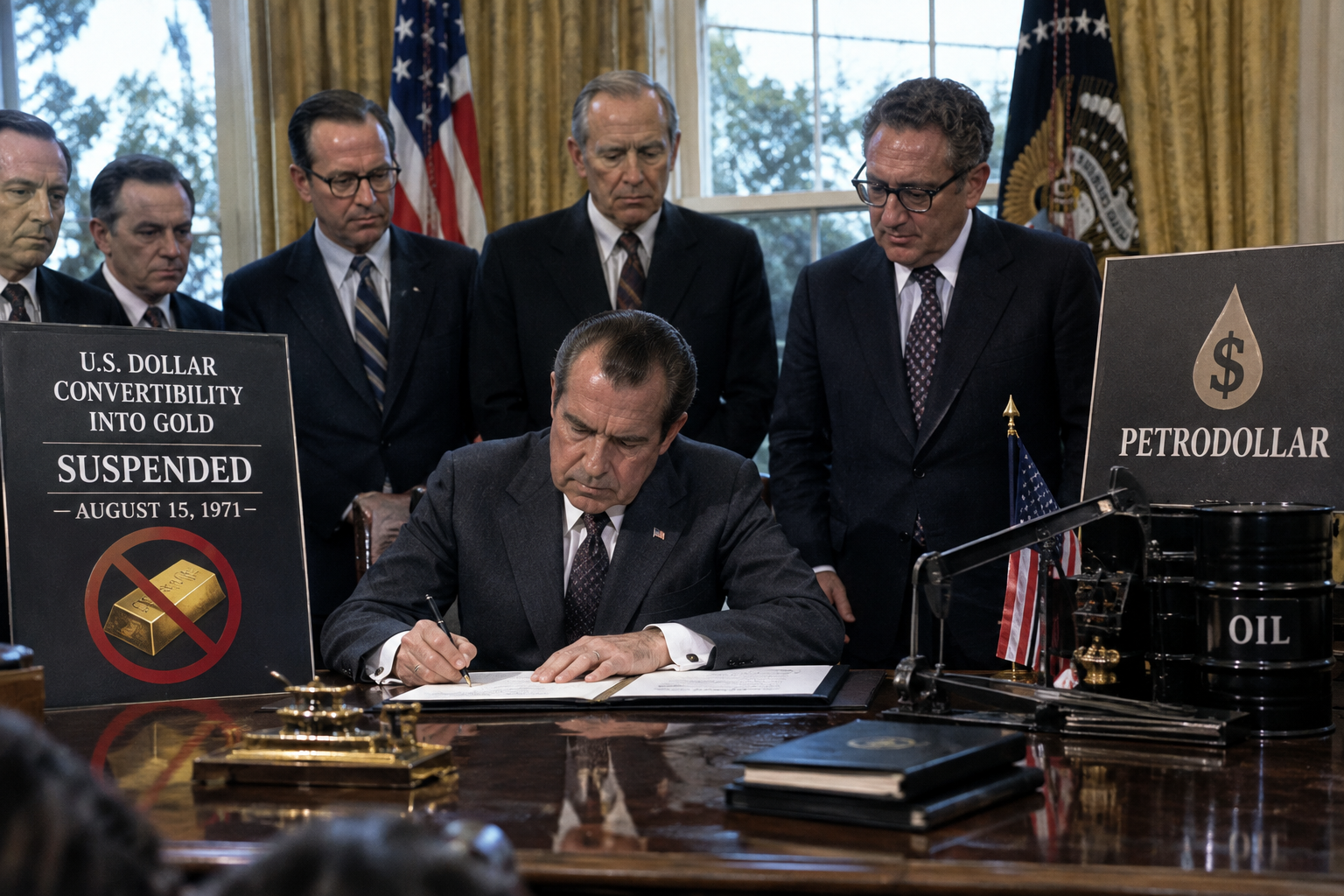
The twentieth century transformed gold once again. After the disruptions of the First and Second World Wars, governments sought a new international monetary system. The Bretton Woods system, created in 1944, placed the United States dollar at the center of the international monetary system while maintaining a fixed relationship between the dollar and gold. Under the system, the official dollar-gold price was set at US$35 per troy ounce. For several decades, gold therefore remained at the heart of international monetary relations even though ordinary citizens increasingly used paper currencies rather than gold coins.
In 1971, President Richard Nixon ended the convertibility of US dollars into gold, effectively ending the central feature of the Bretton Woods monetary system. The world moved toward floating exchange rates, and gold was no longer the foundation of national currencies. Yet gold did not lose its importance. Instead, it developed a new identity as an investment asset, central-bank reserve, store of value, jewelry material, and industrial commodity. Investors increasingly bought gold bars, coins, and later exchange-traded products as a way of diversifying portfolios and seeking protection during periods of economic or political uncertainty.
Today, gold occupies a unique position at the intersection of history, finance, technology, art, and human culture. Central banks continue to hold gold reserves, while jewelry remains one of its largest traditional uses. Modern technology has also created new applications in electronics, aerospace, medicine, and precision engineering because gold conducts electricity well and resists corrosion. From the first prehistoric ornaments to the vaults of modern central banks, gold has survived thousands of years of changing civilizations. Empires have risen and disappeared, currencies have changed, and technologies have transformed the world, but humanity's fascination with this remarkable metal has endured.