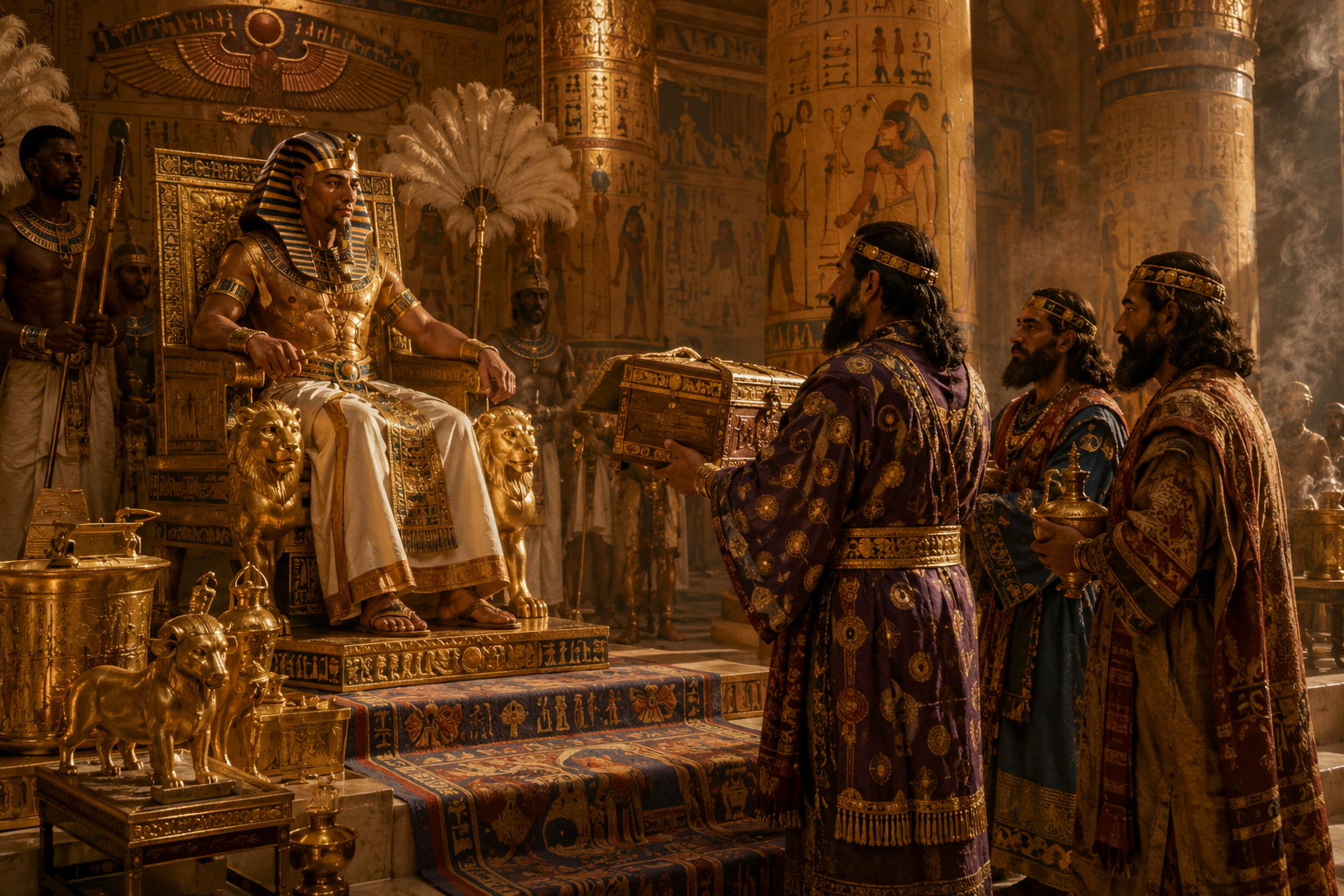
By the third millennium BCE, gold had become an established material in the great civilizations of the ancient Near East. In Mesopotamia, the Sumerians used gold for jewelry and prestige objects, while the royal cemetery at Ur produced extraordinary quantities of precious materials. Gold chains, ornaments, vessels, beads, and decorative objects reveal that ancient craftsmen had developed sophisticated techniques for working the metal. Gold was not merely decorative; its possession demonstrated access to resources, skilled labor, long-distance trade, and political power.
Egypt became one of the most important gold-producing regions of the ancient world. Gold was mined in the Eastern Desert and in Nubia, south of Egypt, whose name was closely associated with gold. Egyptian miners exploited both surface deposits and underground sources, while the state organized labor and transportation over enormous distances. Egyptian inscriptions from the early second millennium BCE provide evidence for the importance of gold, and the Egyptians eventually created extensive mining settlements in remote desert regions. The Turin Papyrus, created much later during the New Kingdom, preserves a detailed map of a gold-mining region and is among the earliest surviving maps associated with mining.
Gold also became increasingly connected with religion and the afterlife. Egyptian rulers and elites were buried with precious objects because gold was regarded as an appropriate material for gods, kings, and eternal existence. Egyptian craftsmen developed techniques including wirework, granulation, soldering, and filigree, allowing them to transform small quantities of gold into extraordinarily detailed objects. By the end of this era, gold had become much more than a rare natural curiosity: it had entered the political, religious, artistic, and economic systems of civilization.